


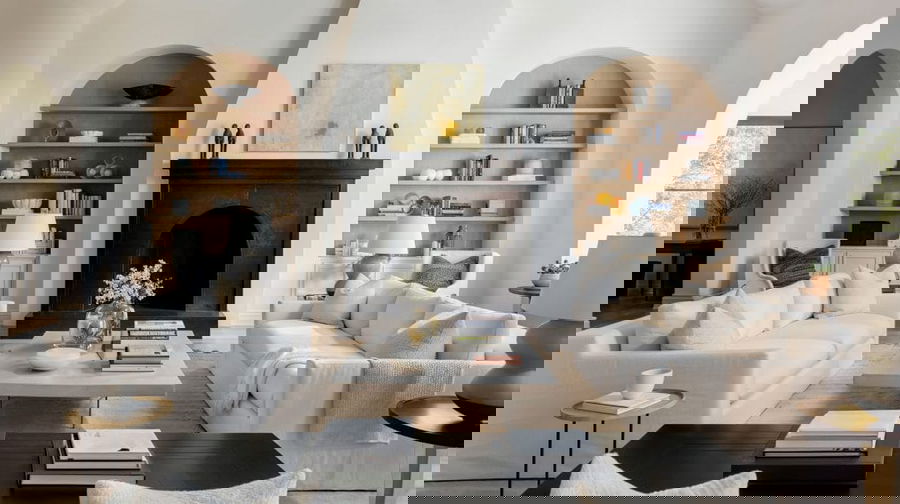
Looking to add timeless charm to your home? Spanish Revival interior design brings warmth, character, and elegance, blending old-world influences with modern sensibilities. From stunning arches to intricate tilework, these elements will transform any space into a beautiful, inviting retreat.
What is Spanish Revival Interior Design
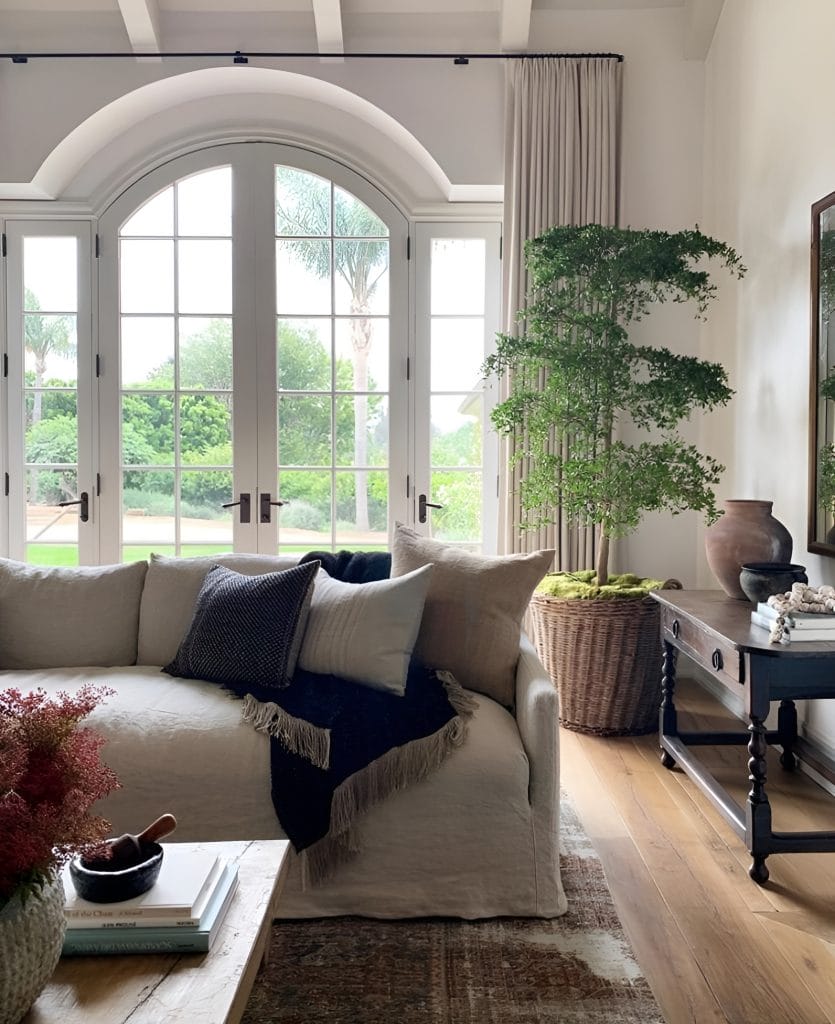
As a distinctive interior design style, contemporary Spanish Revival draws its foundation mainly from the homes built in California and the American Southwest between 1915 and 1940. These houses adapted elements of Spanish colonial, Mediterranean, and Moorish architecture into a format that made sense for new construction.
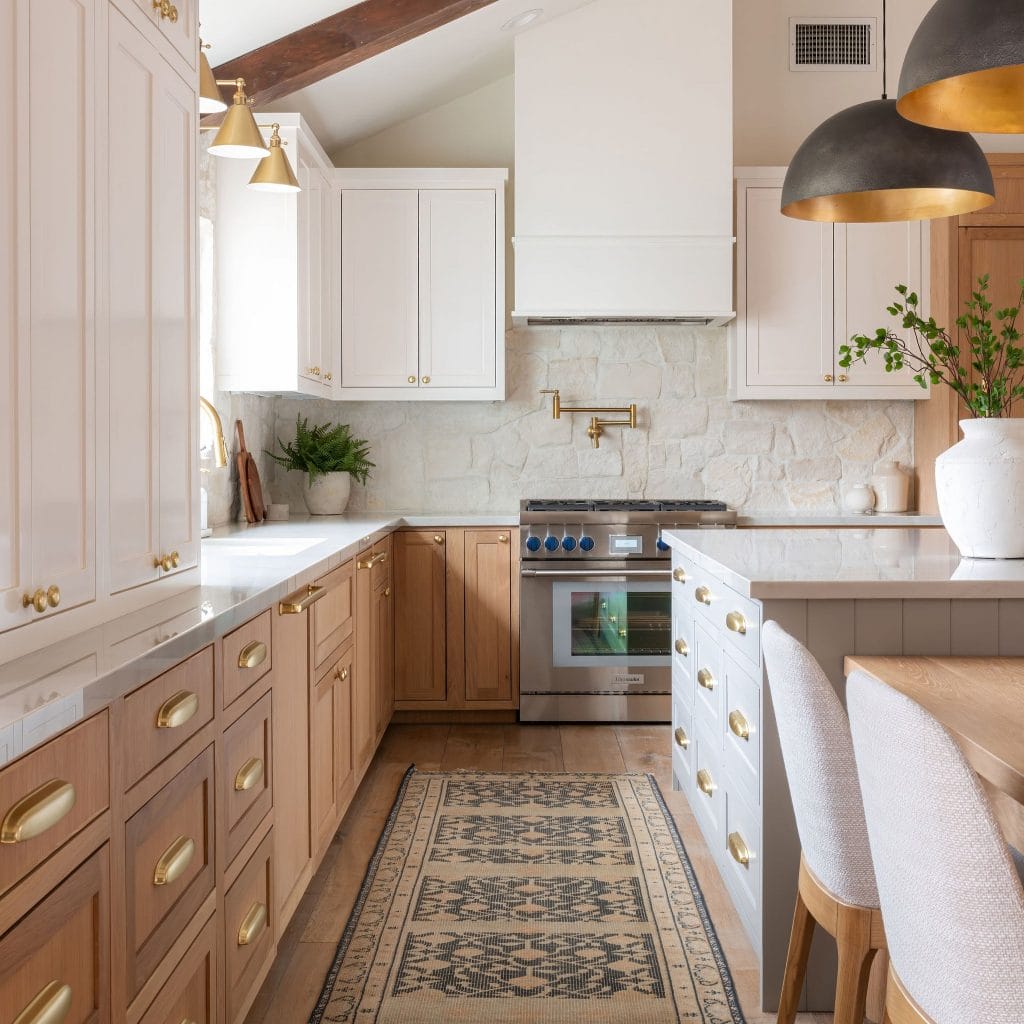
The bones of Spanish Revival architecture rest in mass, curve, and contrast: thickened walls, high ceilings, exposed beams, and the interplay of cool stucco against warm wood or tile. Unlike later minimalist movements, Spanish Revival interiors operate on the premise that surfaces hold character and cultural memory.
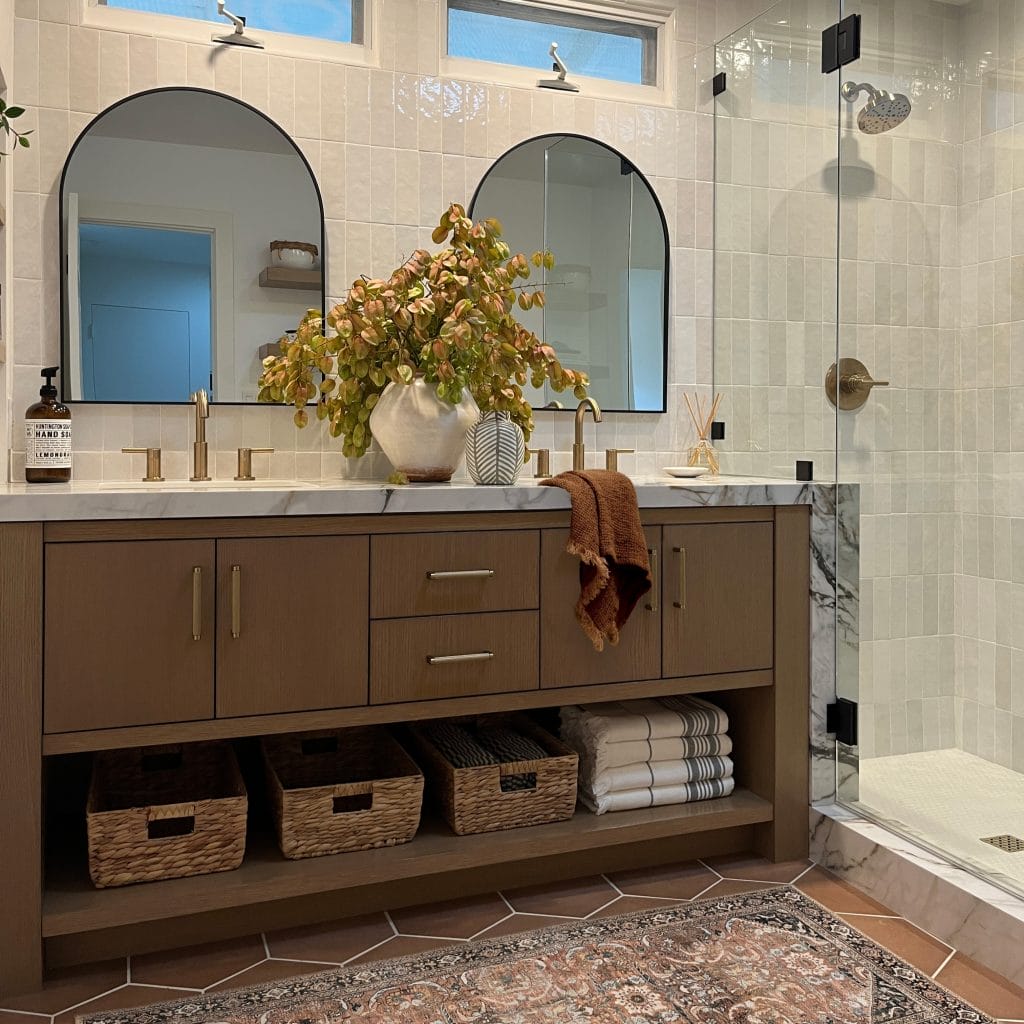
The layout often follows axial lines but introduces asymmetry through arched niches or recessed alcoves. Where other historical revivals favored ornamentation through applique, modern Spanish design embeds decoration into structure, such as a built-in bench under a window or a tiled riser on a stair.
Pro Tip: Love Spanish Revival interior design, but not sure which look fits your taste? Try our Free Interior Design Style Quiz to discover your ideal style today!
Spanish Revival Design Elements You’ll Love
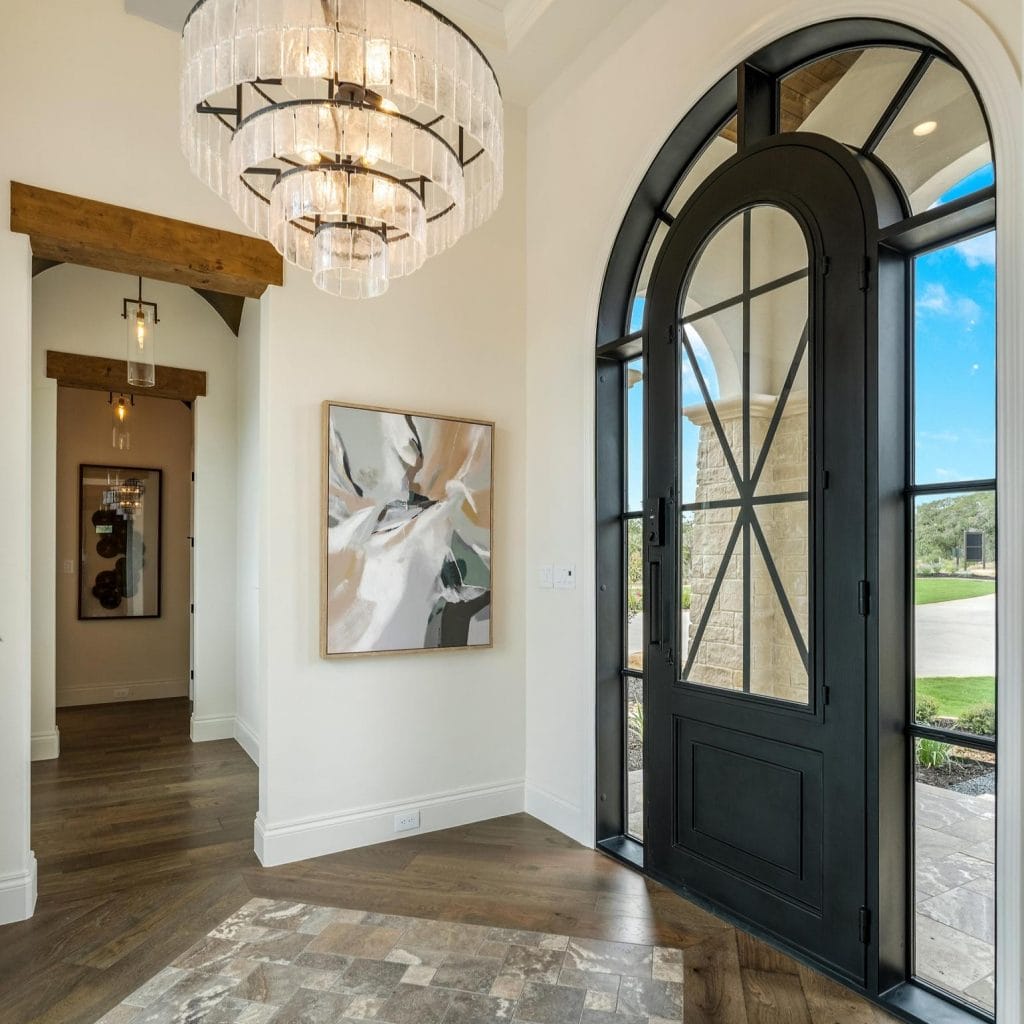
Spanish Revival interior design stands out for its architectural clarity. The proportioning systems and structure-based decoration give designers a strong framework for creating interiors with presence. When you understand the rules, you can update original homes or integrate Spanish Revival decor into contemporary transitional spaces.
1. Forged Iron Fixtures
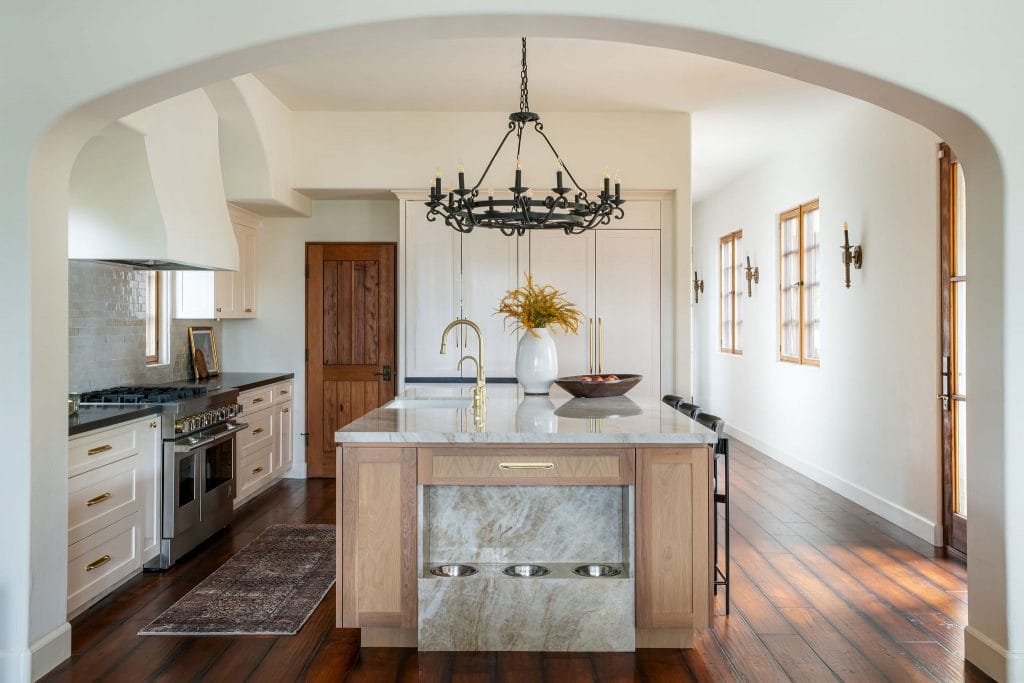
Spanish Revival lighting depends on forged iron, so you should give it priority over cast metal or painted aluminum. The difference is tactile and structural. In period homes, lighting fixtures were often custom-made, with hand-shaped curvature: scrollwork chandeliers, strap-iron wall sconces, lantern pendants with mica or seeded glass. When sourcing replacements or new designs, look for visible rivets and rough welds that would give the fixture more presence.
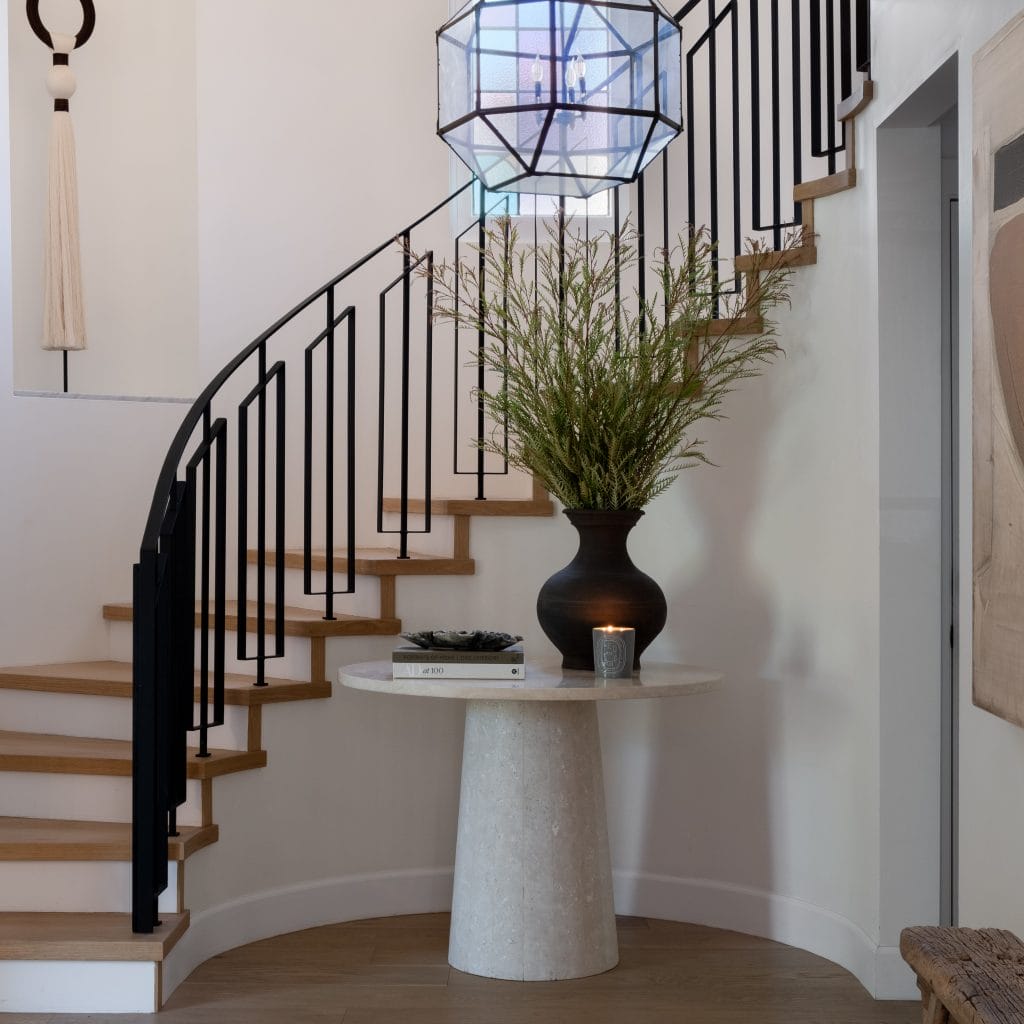
Create a cohesive flow using forged iron in curtain rods, stair railings, and even cabinet pulls. Each decorative piece will connect right back to Spanish Revival architecture through its tension between strength and detail.
2. Arched Niches and Recesses
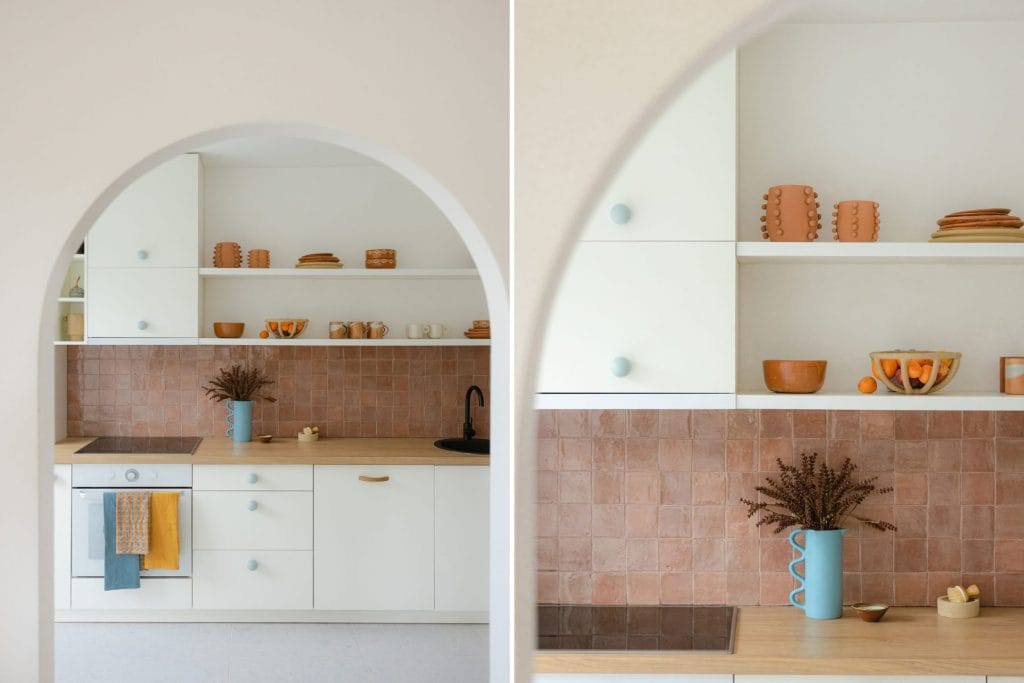
Wall depth enables carving in Spanish Revival homes, so the walls themselves become furniture. Arched niches are often used for statues or ceramics or filled with recessed shelving. Thickened sills, meanwhile, become perches in forms that rely on structure.
Be careful here: drywall over studs will hardly hold the curve. Proper niches require framing that supports their volume, typically a true arch or parabolic curve, rather than a soft rectangle. Light can be wired directly into these spaces to create glow fields around objects.
3. Weight-Bearing Wood Ceilings
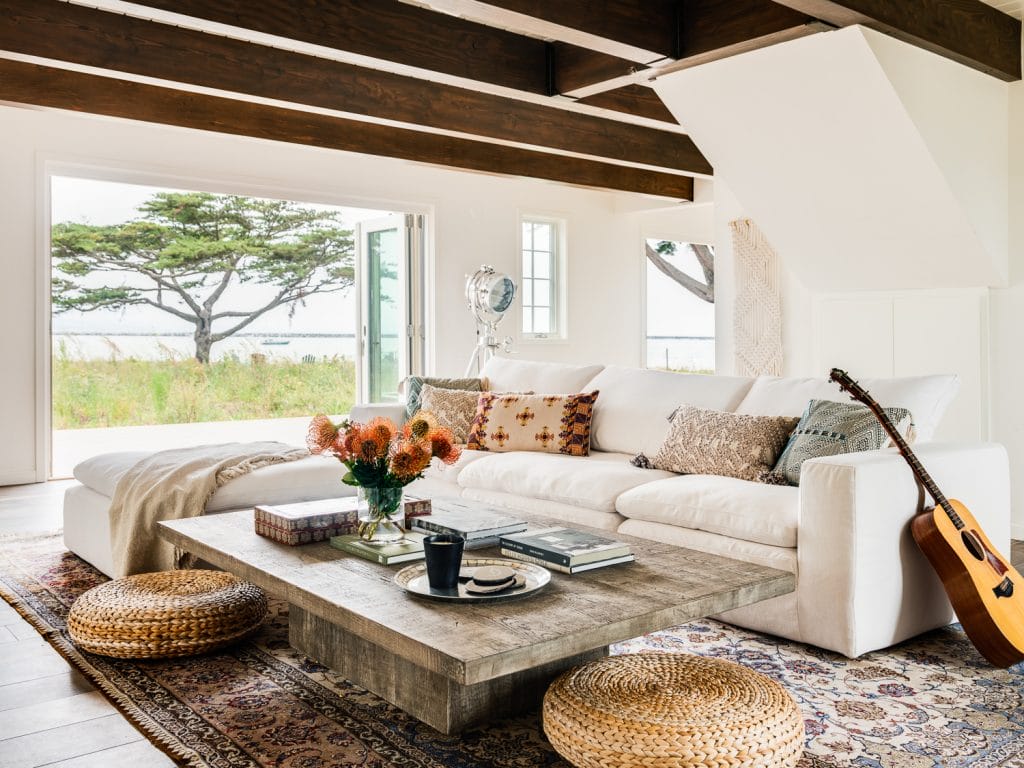
Exposed wood beams are the structural and visual spine of many Spanish Revival-style interiors. The beams are usually stained dark, cut square, and spaced generously to let the ceiling plane stretch between them. Often made from Douglas fir or redwood, they call for a wide span and low sheen.
In renovation work, it’s best to expose original beams when possible. Avoid hollow faux beams unless they carry the correct mass and joinery. Pegged ends, chamfered edges, and proper spacing will create the visual rhythm that defines the upper third of a Spanish Revival living room.
4. Textured Floors in Natural Materials
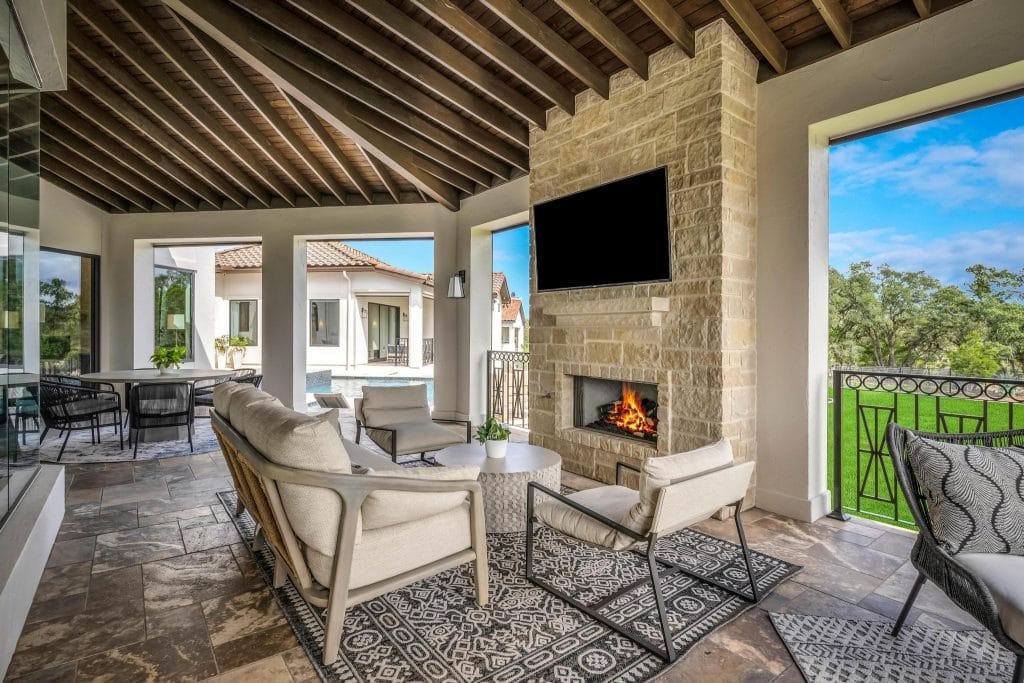
Flooring in Spanish Revival interiors relies on material contrast and underfoot resonance. Saltillo tile, reclaimed oak, dark walnut, and matte-finish stone typically set the palette. Avoid uniform gloss—clay tile laid in irregular shapes works much better. Wide-plank wood boards with beveled edges are also an option, as well as hand-cut stone pavers.
Transition thresholds should be physical, like a single step down into a sunken room or a row of tile inset into a hardwood floor to make the boundary legible. A piece of advice: these floors carry both sound and weight, so install them over a solid substrate.
5. Decorative Tilework
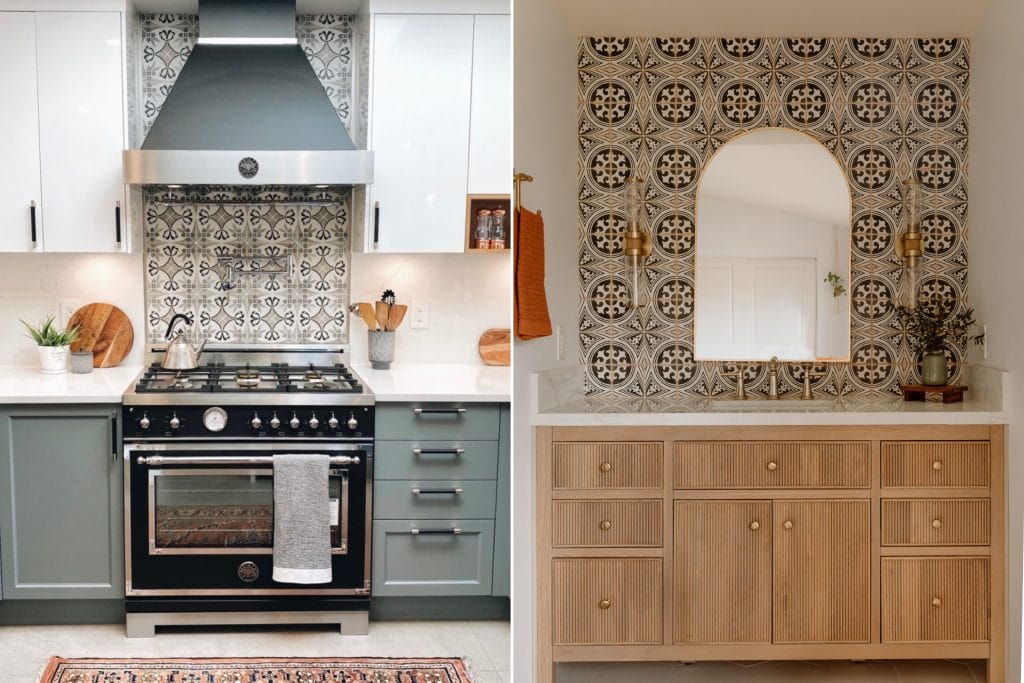
No surface carries more cultural layering than Spanish Revival tile. It appears everywhere from thresholds, fireplace surrounds, stair risers, to kitchen hoods and fountain edges. A single strip can stretch across a doorway or be layered as a dense field in a backsplash. That’s because in Spanish Revival interiors, tile not only covers large planes but also punctuates them.
The tilework should be genuine, properly laid, grouted, and finished with a clean edge. Patterns often mix Moorish geometry with Mexican craft and Andalusian palette structures, which puts cobalt, olive, ochre, and terracotta shades at the forefront.
6. Plaster Wall Finishes
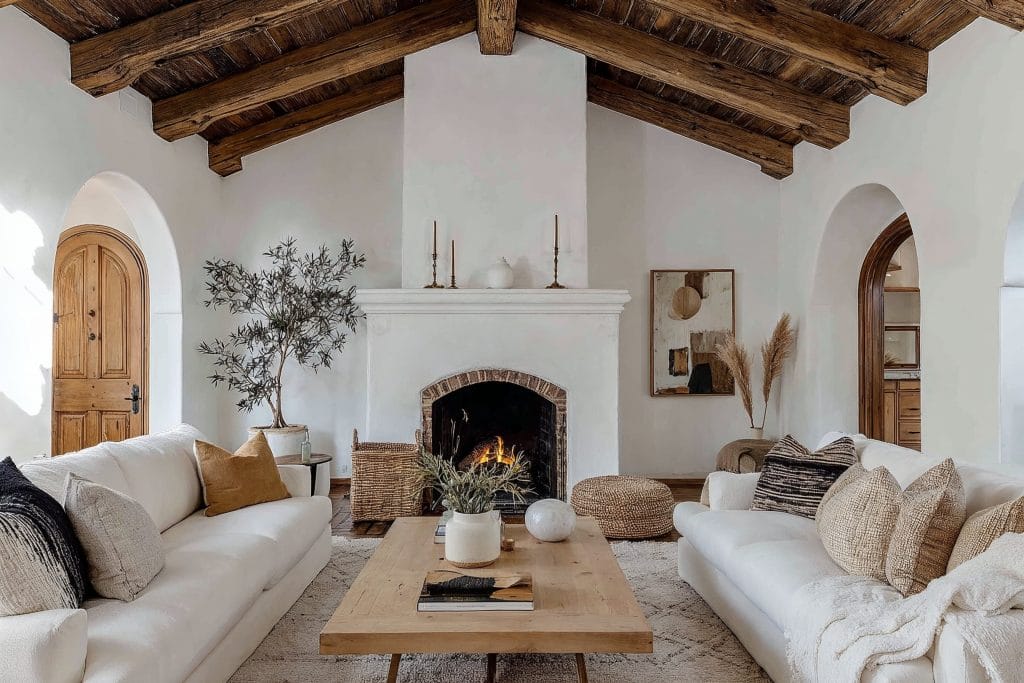
Flat drywall has no role in the Spanish Revival interior design style. The walls need depth, and that comes from actual troweled plaster. Go for lime-based when feasible—if not, use synthetic finishes matched to historical aggregates.
Keep in mind that slight imperfections in the finish give form to the hand. Unlike paint, plaster diffuses light through irregularities and mineral particles, giving the walls movement and tone without needing additional pigment. However, rounded corners and arched doorways should be skimmed as a continuous surface, not broken into parts.
7. Fireplaces as Structural Centerpieces
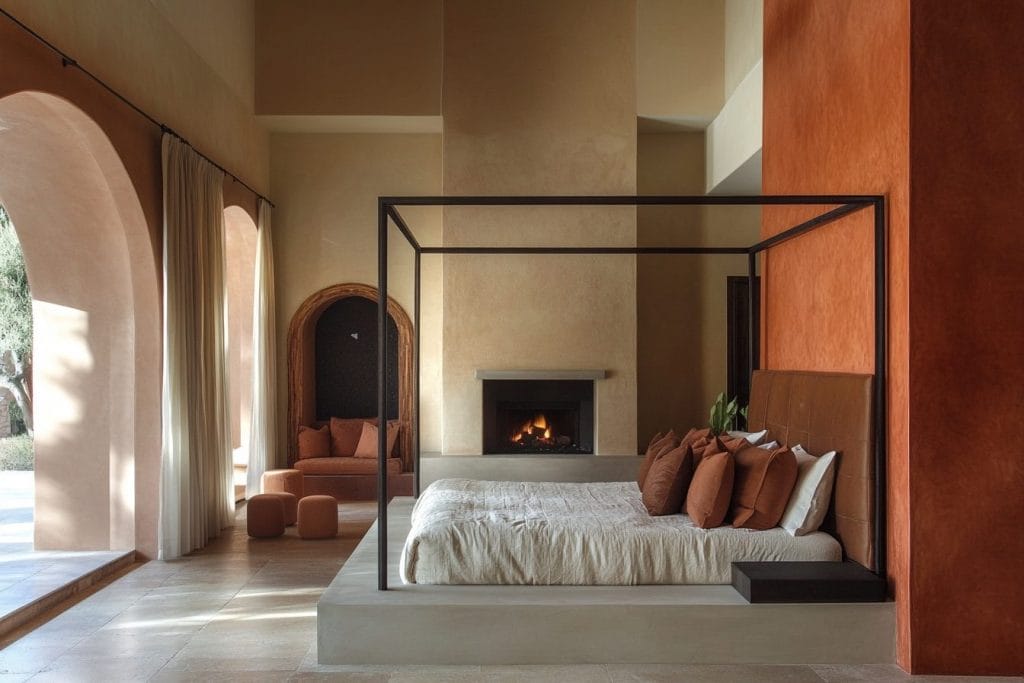
The fireplace is usually authentic and central in Spanish Revival design. It’s a structural block, often with a raised hearth, stepped shoulders, and a tapering chimney breast. Tile or plaster usually wraps the firebox surround, while a heavy wood or stone lintel caps the composition.
In newer homes, it’s worth framing a proper masonry core to recreate the feel. However, avoid flat screens or wall-mounted decor above. The fireplace should read as a mass and a spot where the room finds its stillness.
8. Artisanal Spanish Revival Decor & Furniture
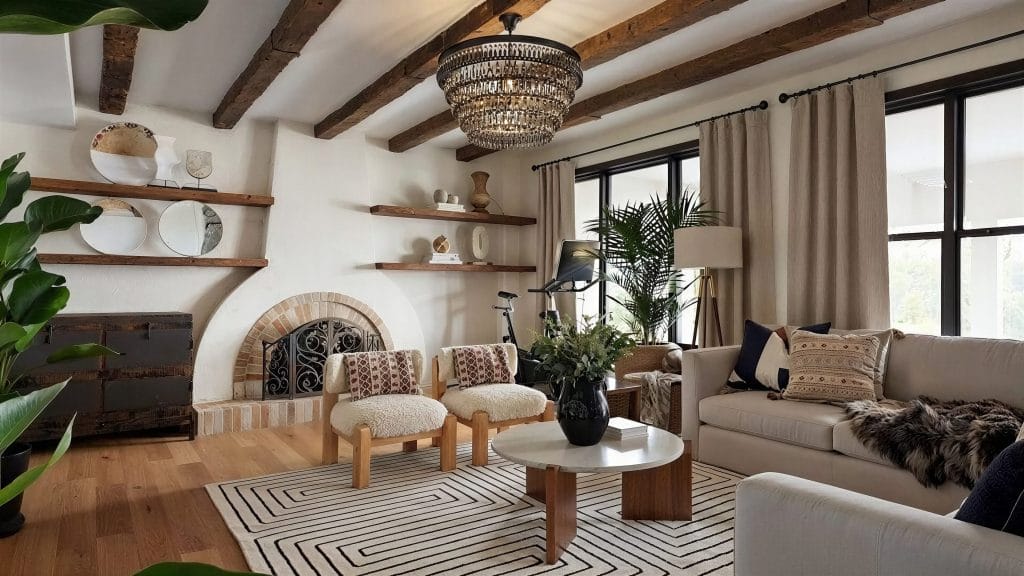
In a Spanish Revival living room, decorative objects find their place based on the room’s established rhythm. The space maintains its dimensions through careful design, with each item harmonizing with the environment. Consider a vessel made from mineral clay resting on tile where the floor shifts direction, or woven panels stretched across recessed fields, held in place by hidden nailers.
A chair with pegged joinery and thick hardwood rails complements the overhead span and the wall’s compressed depth. Similarly, a Spanish chest with board-on-frame construction fits perfectly in a plastered recess, its dimensions tailored to the space. Surfaces are often sealed with wax or oil, preserving the grain’s openness to air and touch.
Designer Recommended Spanish Revival Furniture & Decor
Spanish Revival decor pulls from both heritage craftsmanship and region-specific adaptations. Carved wood pieces, leather-strapped chairs, antique tile-topped tables, and iron canopy beds all play core roles. Key pieces can be oversized. Here’s a selection that carries forward the scale and intention of Spanish Revival interiors.
Why Those Work
- Delphia Sconce: Bronze and hand-rubbed brass carry the forged-metal tradition that Spanish Revival walls expect from their sconces.
- Tamara Media Console: Dark wood carcass with visible joinery references the heavy case goods common to the tradition.
- Cafe Mesa Chair: Turned wood and a rush-style seat belong to the stylish vernacular Spanish Revival interiors draw from.
- Bull Natural Iron: Iron bull figure on a tabletop picks up the Andalusian source material.
- Arc 60″: Curved base works against the rounded archways and plaster niches typical of this style’s architecture.
- Sorrento Rug: Distressed pattern in warm tones reads as an aged textile, which suits tiled or saltillo floors.
- Daydream Believer: Muted palette gives a plastered wall something to hold without competing with the architectural weight around it.
- Casmus Mirror: Black iron frame echoes the grillework Spanish Revival interiors carry on windows and stair railings.
- Durga Iron Work Candleholders: Wrought-iron form ties back to the hardware and fixtures that define the tradition’s material language.
Looking for Spanish Revival interior design?
Partner with a professional designer to nail the look in your home. Book your Free Online Interior Design Consultation to get started today!




Comments